December 28th, 2016

Watching the clock tick down the final seconds until midnight, many of us- Joel Martinez, DDS included- feel nostalgic about the passing year and hopeful about the new one to come. New Year’s Eve is one of the most widely celebrated holidays in the world, with over-the-top celebrations taking place in dozens of countries. The Gregorian calendar, which is widely used in Western nations and around the world, was implemented in 1582. Since that time, December 31st has marked the final day of the year, with midnight heralding the beginning of a brand new year. In the United States, New Year’s Day is a public holiday; government offices, schools, public organizations, and many businesses are closed for the day. Ponder the following fun facts as you think about your plans for the holiday:
- Approximately one billion people watch the New Year’s Eve ball drop in Times Square, New York City. This televised event is one of the most iconic New Year’s celebrations in the world. For many years, watching the ball drop meant tuning in to Dick Clark’s Rockin’ New Year’s Eve, an iconic television special dear to the hearts of many viewers.
- The idea for the New Year’s Eve ball came about because of a citywide ban on fireworks. Before 1907, when fireworks became illegal in New York City, celebrations included an elaborate fireworks show. The large, glittering, illuminated ball was developed as an alternative. Although the first ball was heavy at 700 pounds, the modern New Year’s Eve ball is made of Waterford crystal and tips the scale at six tons!
- The top five New Year’s resolutions are: to lose weight, quit smoking, get a new job, return to school, or increase personal savings. However, approximately 88% of New Year’s resolutions fail. But don’t let that discourage you! Resolutions are most likely to succeed when they are clear, achievable goals. Setting out a concrete plan to achieve your resolution also boosts your chances of success.
- Eating black-eyed peas on New Year’s Day is said to bring good fortune in the new year. Collard greens, cabbage, and ham hocks are also considered lucky foods to enjoy. Just steer clear of the chicken or turkey dinners; eating poultry is a bad omen for the year to come.
Whether you plan to stay in McAllen, or head out into the crowds to watch the ball drop in Times Square, New Year’s Eve is a time to enjoy friends and family. Send your loved ones well wishes for the New Year, and look for that special someone to share a midnight kiss with for good luck!
December 21st, 2016

You have done a lot of work to get the perfect smile. You wore your Invisalign aligner trays and cared for your teeth, and now your treatment is done. You still need to take care of your teeth to keep your beautiful smile. Keeps these things in mind when you think about your oral care routine.
Retainers
Many patients do require a retainer after Invisalign treatment. This will be based on your unique situation. If a retainer is recommended by Dr. Joel Martinez, Dr. Christopher Martinez, and Dr. Vanessa Martinez, use it as directed. Retainers prevent your teeth from shifting back into their original position. You should also avoid hard, crunchy foods for the first couple of weeks as your teeth adjust. For younger patients, retainers are normally used until the wisdom teeth come in or are extracted.
Brushing and Flossing
Brushing and flossing must be part of your daily oral care. Flossing helps remove the plaque, which becomes tartar or calculus. This build up can lead to gingivitis and gum disease. Your gums may be more sensitive for a week or two after your orthodontic work is completed. A warm salt water rinse may relieve discomfort.
Your teeth may be slightly sensitive for a short time. They have been protected by your Invisalign aligner trays and now are fully exposed. You might want to try a sensitive toothpaste to get through the transition. Just ask; we will be glad to recommend the best type for your needs. If your teeth are stained, a professional whitening treatment can be considered.
Regular Dental Checkups
You still need to have regular dental exams. Professional cleanings and X-rays make sure that both your teeth and gums stay healthy so you can keep your teeth for life. If cavities or other problems are found, they can be taken care of quickly.
If you have any questions about how to care for your teeth after your Invisalign program, please ask our McAllen team. We want you to keep your healthy smile and enjoy the results of your Invisalign treatment.
December 14th, 2016

Thanks for asking! It really depends on the dental age of the patient rather than their chronological age. Usually a good time to have your child evaluated by an orthodontist is after the front permanent teeth have erupted into the mouth or if there appears to be extreme crowding of the teeth.
The American Association of Orthodontists recommends that children between the ages of seven and nine should be evaluated by an orthodontist. There are times when an early developmental treatment is indicated to correct situations before they become major problems. In these circumstances the patient will most likely benefit from a second phase of orthodontics when all of their permanent teeth have erupted.
Most full orthodontic treatment begins between ages nine and 14, and lasts from one to three years, with two years being the average. It’s important, however, that children be screened at an early age for Dr. Joel Martinez, Dr. Christopher Martinez, and Dr. Vanessa Martinez and our staff to assess if your child can benefit from orthodontic treatment and when treatment should begin.
We hope this helps, and invite you to give us a call if you have any questions about your child’s treatment at Joel Martinez, DDS.
December 7th, 2016
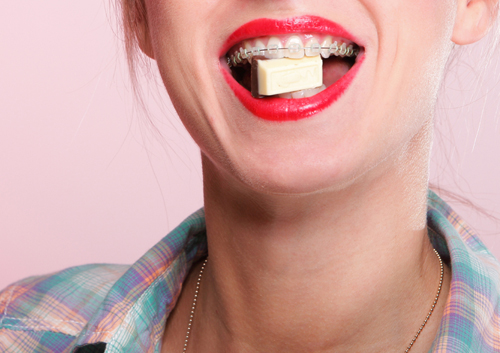
Sticky, hard, and gooey: these candies fill your dopamine receptors with spasms of sugar-filled joy, but if you’re undergoing orthodontic treatment at Joel Martinez, DDS to straighten your teeth, then these sweets are not so sweet. While you may have a Willy-Wonka-sized sweet tooth, there are some candies you’re going to have to avoid while wearing braces.
Here are five bracket- and wire-destroying culprits that Dr. Joel Martinez, Dr. Christopher Martinez, and Dr. Vanessa Martinez and our team recommend leaving on the candy aisle and not put in your mouth, no matter how tempting they may be.
- Gum is sticky and stringy. It can get tangled like fishing net in your braces. You don’t want to be that boy or girl trying to pull knots of Wrigley’s out of your braces without being seen.
- All chewy, gooey candies need to be avoided. When you’re wearing braces, don’t even think about putting a caramel candy in your mouth. Caramel will not only stick to your braces, making it look as if you haven’t brushed your teeth in a week, but the gooey texture can pull apart the wires, and trigger an emergency visit to Joel Martinez, DDS.
- Hard candy may seem like a safe choice, but it’s not. What’s the problem? Nobody ever just sucks on hard candy; sooner or later, we bite down on it. Biting a hard candy may cause part of your braces to snap. Furthermore, once the candy is broken into a bunch of little pieces, it’s not uncommon for one of those sugary shards to get wedged between your braces and teeth … and that’s a cavity waiting to happen.
- The taffy you enjoy getting at a seaside boardwalk is going to have to go on the back burner. Like caramel, taffy can pull apart and damage your braces. You don’t want to have your expensive orthodontic gear replaced.
- Please, just one lollipop? Nope. A lollipop is nothing more than hard candy on a stick. If you can’t have hard candy during orthodontic treatment, then you shouldn't have hard candy on a stick either.
Have any more questions about what you can and can’t eat when you have braces? Please give us a call at our convenient McAllen office to learn more, or ask Dr. Joel Martinez, Dr. Christopher Martinez, and Dr. Vanessa Martinez during your next adjustment visit!