Our Blog

What is hyperdontia?

October 14th, 2020

When a child is born, he or she will have 20 primary teeth and 32 permanent teeth. But sometimes kids are born with additional teeth, and our team at Joel Martinez, DDS calls this oral condition "hyperdontia." Primary teeth are the first set of teeth that erupt in your child's mouth, typically by the time they are 36 months old, and are shed by the time your child reaches the age of 12. Permanent teeth then take the place of the primary teeth and are usually fully-erupted by the time your son or daughter reaches 21 years of age. Anyone who develops more than 20 primary teeth or more than 32 permanent teeth has hyperdontia, and the additional teeth are referred to as supernumerary teeth.

While the cause of hyperdontia is not entirely clear, it is believed that there may be a genetic factor. Oral professionals have found that patients with extra teeth often have syndromes like cleidocranial dysplasia, Ehler-Danlos syndrome, Gardner syndrome, or cleft lip and palate. The prevalence of hyperdontia affects between one and four percent of the population in the United States, and the majority of cases are limited to a single tooth.

So, what is the best way to deal with hyperdontia? It really depends on the case. The treatment plan your doctor suggests varies according to the potential problem posed by the supernumerary teeth, as well as their type. Orthodontic treatment may certainly may help, but extraction can also be a good option. We recommend that children receive an oral evaluation or checkup no later than the age of seven. In addition to hygiene evaluation, this helps ensure your child does not experience hyperdontia problems.

If you suspect you or your child may be suffering from hyperdontia, please give us a call to schedule an appointment at our convenient McAllen office to be evaluated.

Don’t let braces ruin your Halloween

October 7th, 2020

Halloween is a time to enjoy delicious candies you might avoid the rest of the year. Youngsters who get to dress up and ask for sweet treats out trick-or-treating cherish this holiday.

If you have braces on, Dr. Joel Martinez, Dr. Christopher Martinez, and Dr. Vanessa Martinez would like you still to have fun and celebrate Halloween this year!

It’s easy to get carried away on Halloween by eating too much candy at once. Most parents try to prevent the all-too-common sugar high their kids experience on Halloween night. While there are certain candies that should be avoided, not all candy will cause problems for kids with braces. After trick-or-treating, you could trade unsafe candies with siblings and/or friends so they don’t miss out on the sugar buzz.

Dr. Joel Martinez, Dr. Christopher Martinez, and Dr. Vanessa Martinez and our team have come up with a list of teeth-friendly treats that should keep you from worrying about breaking your braces. We also came up with a list of candies to avoid, so as to save you a trip to our McAllen office. Remember to be extra careful when you indulge this Halloween!

Braces-Friendly Sweets

  • Solid chocolate: Milk, white, or dark
  • Nougat-filled candy bars: Three Musketeers
  • Powdery candy: Sweet Tarts, Pixie Stix
  • Mint-flavored candy
  • Malted milk balls
  • Soft cookies
  • Peanut butter crackers

Avoid These Treats

  • Sticky candy: Starbursts, toffee, Tootsie Rolls
  • Hard candy: Suckers, Jolly Ranchers
  • Taffy
  • Caramels
  • Fruit chews
  • Gum
  • Caramel apples
  • Skittles
  • M&Ms

When in doubt, ask Dr. Joel Martinez, Dr. Christopher Martinez, and Dr. Vanessa Martinez if a particular candy is safe to eat when you have braces. We hope you enjoy your Halloween sweets, and look forward to seeing you at your next appointment! Happy Halloween!

Fantastic Elastics

September 30th, 2020

If you already wear traditional braces, you know all about these helpful little rubber rings. But if you are new to the world of braces, you might like to know just what kind of elastics are available and what they can do for you.

  • Ligatures: Alignment Assistance

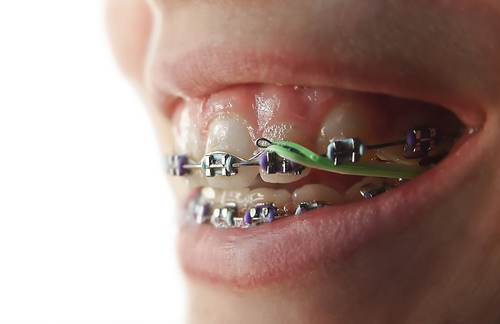
When you get your braces, the brackets you’ve chosen will be bonded to your teeth. Once they are attached securely, an arch wire will be threaded through the brackets to provide consistent gentle pressure, moving your teeth into their best positions. But what holds that wire in place? This is where those tiny, colorful bands, called ligatures, come in. Fit snugly around the wire and the bracket, they keep the wire where it needs to be to move your teeth to a better alignment.

There are also ligatures call “c-chain ligatures,” or “power chains.” These tiny ligature bands are connected to each other, and fit across the brackets in one long strip. This design lets them not only hold your wires in place, but help move your teeth closer together at the same time. They come in a variety of sizes depending on the spacing of your teeth, and might be worn weeks or months as needed.

One thing to remember is that while ligatures are essential, they are not permanent! Every time you have your wires tightened or replaced, you can make this an opportunity to express your personality through your choice of bands. There is a wide variety of color choices available, so take advantage of it!

Show your school spirit by displaying your high school’s colors. Go orange and black for Halloween. Match your ligature tones to your go-to clothing colors. Or, go monochromatic. Match grey or silver bands to your brackets, or choose white or clear bands if you have ceramic brackets. (One word of caution—light colored ligatures can pick up stains from dark foods and drinks. On the other hand, they won’t be around that long!)

  • Rubber Bands: Building Better Bites

While ligatures are the colorful attention-getters in the elastics world, there are other bands that do very important work. When you have a malocclusion, or bad bite, your upper and lower jaws don’t fit together perfectly. We use rubber bands to align your bite correctly and carefully move it into the proper position. This is accomplished by attaching bands to tiny hooks on specially chosen brackets on the upper and lower teeth. The bands usually connect an upper bracket to a lower one, and are specifically placed to correct your unique bite problem.

If you need this type of elastic, you will play a very important part in making your orthodontic treatment work. You will probably need to wear your bands 24 hours a day, removing them only for brushing and flossing. (Talk to us about how to work with your bands when you are eating, playing an instrument, or wearing a mouthguard.) And they need to be replaced several times a day, which is where you come in.

Even if the bands look perfect, after hours of work, they lose the tightness needed to keep moving your teeth to their best position. Bands that are too loose won’t be as effective. On the other hand, doubling the bands is a bad idea because that might apply too much force. Bands come in a variety of sizes and strengths, and yours have been chosen for this specific phase of your treatment. Keep calm, keep to a schedule, and keep a supply of bands on hand in case one breaks, and everything will work out.

If this sounds like a lot of confusing information, don’t worry! Dr. Joel Martinez, Dr. Christopher Martinez, and Dr. Vanessa Martinez will supply you with the right bands for your treatment, clear instructions on where and how to place them, and practice time for putting them in. You’ll probably need a mirror at first, but you’ll become an expert in no time.

If you ever have questions we can help you with, contact our McAllen office immediately. We are here to guide you through the process and help you with any problems you might have. Wearing your bands consistently and correctly will help you achieve your beautiful smile in the shortest time possible. And that’s an accomplishment that is truly fantastic!

Does smoking affect oral health?

September 23rd, 2020

By now, everyone knows that smoking is bad for you. But the truth is its broad-reaching health effects are not all known by everyone. This is especially true of oral health. Smoking can have serious repercussions in this regard. To give you a better idea of how smoking can affect your oral health, Dr. Joel Martinez, Dr. Christopher Martinez, and Dr. Vanessa Martinez and our team have listed some issues that can arise.

Oral Cancer

Oral cancer can have steep ramifications for anyone that gets it. Surgery can be required to eliminate the cancer before it spreads to more vital parts of your body. Any type of cancer is about the worst health effect you can get, and this especially holds true to the affects that smoking has on your mouth. The type of mouth surgery required with oral cancer can leave your face deconstructed in certain areas, and it is all due to smoking or use of other tobacco products.

Tooth Discoloration and Bad Breath

At the very least, it is fair to say that as a smoker you will often have bad breath, and while you may try to cover it up with gum or mints, tooth discoloration is a whole other story. The chemicals and substances in cigarettes stick to your teeth staining them brown and yellow colors that are increasingly difficult to disguise.

Gum Disease and Loss of Bone

Another effect of smoking is the increased risk of gum disease. Your gums may start to recede, which can eventually lead to the loss of teeth. Smoking can also increase bone loss and density in your jaw which is vital to the health of your mouth. Gum disease and bone loss are two signs that smoking is definitely bad for your mouth.

When it comes to the health of your mouth, the question is not whether smoking affects your health, it's how does it affect your health and to what degree. If for no other reason than because smoking involves your mouth as its entry point, it is safe to say that it can have long-lasting and detrimental consequences on your oral health.

To learn more about smoking and your oral health, contact our McAllen office to schedule an appointment with Dr. Joel Martinez, Dr. Christopher Martinez, and Dr. Vanessa Martinez.

Home About Us For New Patients Orthodontic Treatments Wearing Braces About Orthodontics Contact Us Site Map